Most Higher calculations are worth three marks: one for the Equation, one for the Substitution, and one for the Solution with its Unit. Exam papers call the equation the “relationship”.
IESSUU sets out all three every time. The Information list on the left gets the numbers ready, and the Underline shows the marker your answer. A correct answer on its own gets all three marks; a wrong one gets none. Set out all six steps, and a slip costs you one mark, not three.
Informations = ?s = v̄tE · Equation (1)v̄ = 8.90 m s−1s = 8.90 × 1.53S · Substitution (1)t = 1.53 ss = 13.6 mS U U · Solution, Units (1), Underline
2024 Paper 2, Q1(a)(ii): the horizontal distance a ball travels in 1.53 s at 8.90 m s−1.
The checklist
Information: list every quantity down the left as symbol = value, in SI units, and put ? beside the one you want. Change prefixes here: 6.6 km s−1 becomes v = 6.6 × 10³ m s−1. Choose a positive direction and give each value its sign: u = +6.47 m s−1, a = −9.8 m s−2.
A prefix left in, or two signs that disagree, makes the substitution wrong. Example 1 · Example 2
Equation: copy it exactly as the relationships sheet gives it, with every symbol labelled. One equation, never a triangle.
A wrong equation loses every mark in the calculation. Example 3
Substitution: put the Information values in, powers and all: (1.1 × 10¹⁰)2, not 1.1 × 10¹⁰.
If a square is missing here, only the equation mark is given. Example 4
Solution: keep every digit until the last line, then round the answer to the data: one figure fewer, up to two more, than the least precise value.
Rounding part-way, or too many figures at the end, loses the answer mark. Example 5
Underline the final answer and its unit, so the marker finds it.
Then check it: is the size sensible, and is the sign right?
Also
“Show that”: IESSUU still applies. Start with the equation, show the substitution, and finish by writing the value the question gave you.
Working that does not start with an equation gets no marks. Example 7
Use your earlier answer, even if you think it is wrong. Put it in the Information list and carry on.
A wrong answer used correctly in the next part can still get full marks there. Example 8
Higher traps the examiners keep reporting
Up a slope at constant speed, the forward force is the weight down the slope plus friction. 2024 Q2(a)(ii)
Tension in a coupling: use the mass and friction of the thing being pulled. T = ma on its own scores 0. 2024 Q2(c)
G, not g, in F = Gm1m2/r2. Take constants from the data sheet. 2024 Q4(a)(ii)
Copy subscripts as subscripts. Turning a subscript into a power makes the equation wrong. 2024 report
Gradients: carry the axis’s × 10n into the gradient, and use two points on your line, not data points. 2023 Q14(b), Q14(c)
No long calculator strings or “…” before the answer: copying them causes slips. 2024 report
Past-paper examples
Each step on a real question, in IESSUU order. The green answer gets the marks the marking instructions give. The red answer is a typical answer that loses marks, written from the mistakes examiners reported.
1. Information: change prefixes to SI
2024 Paper 2, Q4(b)(i) · 3 marks
DART had a mass of 570 kg and was travelling at 6.6 km s−1 when it collided head-on with Dimorphos.
Calculate the maximum kinetic energy transferred from DART to Dimorphos during the collision.
Ek kinetic energy (J) · m mass (kg) · v speed (m s−1) · kilo (k) = × 103
✗ A typical answer that loses marks
Ek = ?
m = 570 kg
v = 6.6 m s−1
Ek = ½mv2Ek = 0.5 × 570 × 6.62Ek = 1.2 × 10⁴ J
1 mark out of 3
The speed is 6.6 kilometres per second. Copied into the Information list as 6.6 m s−1, it makes the substitution wrong.
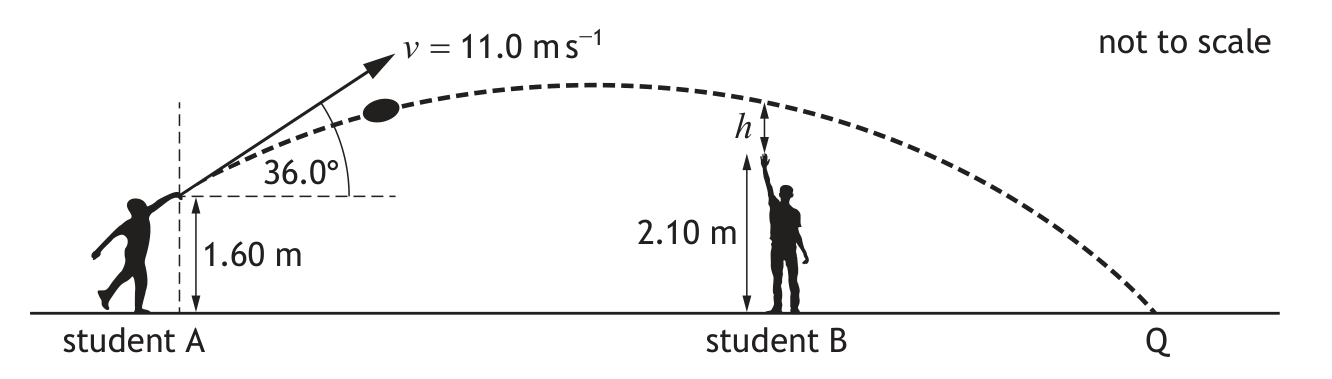
The ball is thrown at 11.0 m s−1 at 36.0° to the horizontal, released 1.60 m above the ground. Its vertical component of velocity is 6.47 m s−1. The ball was directly above student B 0.95 s after it was released. Student B has a maximum reach of 2.10 m.
Determine the height h between student B and the ball.
s vertical displacement (m) · u initial vertical velocity (m s−1) · a acceleration (m s−2) · t time (s)
✗ A typical answer that loses marks
s = ?
u = 6.47 m s−1
a = 9.8 m s−2
t = 0.95 s
s = ut + ½at2s = (6.47 × 0.95) + (0.5 × 9.8 × 0.952)s = 10.6 mh = 1.60 + 10.6 − 2.10 = 10.1 m
1 mark out of 4
u and a are both positive, so the substitution is wrong. Examiners reported this as the most common mistake in this question.
A car pulls a caravan up a slope at a constant speed of 4.0 m s−1. The slope is at an angle of 9.6° to the horizontal. The car and passengers have a total mass of 1650 kg. The caravan has a mass of 1350 kg.
Determine the component of the total weight of the car, passengers, and caravan acting down the slope.
F component of the weight down the slope (N) · W the whole weight (N) · m mass (kg) · g 9.8 N kg−1 · θ angle of the slope
✗ A typical answer that loses marks
W = ?
m = 1650 + 1350 kg
g = 9.8 N kg−1
θ = 9.6°
W = mg sin θW = (1650 + 1350) × 9.8 × sin 9.6W = 4900 N
0 marks out of 3
W stands for the whole weight, so “W = mg sin θ” is a wrong equation. The marking instructions do not accept it, so the right number cannot earn the other two marks.
✓ Gets all the marks
F = ?
m = 1650 + 1350 kg
g = 9.8 N kg−1
θ = 9.6°
F = mg sin θF = (1650 + 1350) × 9.8 × sin 9.6F = 4900 N
3 marks out of 3
A labelled component, such as Wparallel = mg sin θ, is also accepted.
4. Substitution: show every power
2024 Paper 2, Q4(a)(ii) · 3 marks
The mass of Didymos is taken to be 5.3 × 10¹¹ kg. The mass of the Earth is 6.0 × 1024 kg. The distance between Earth and Didymos was 1.1 × 10¹⁰ m.
Determine the gravitational force between Earth and Didymos.
F force (N) · G 6.67 × 10⁻¹¹ m3 kg−1 s−2 (data sheet) · m1, m2 masses (kg) · r distance between them (m)
On a straight, level road the car and caravan accelerate at 0.16 m s−2. The caravan has a mass of 1350 kg. The frictional force acting on the caravan is 1200 N.
Determine the tension in the coupling between the car and caravan.
F unbalanced force (N) · m mass of the caravan (kg) · a acceleration (m s−2)